
Texas Inmate Population
Texas has an unusually large and decentralized custody system. The state has 254 counties, a statewide prison agency in the Texas Department of Criminal Justice, county jail oversight through the Texas Commission on Jail Standards, a statewide victim-notification transition to Texas IVSS-Counties, several federal Bureau of Prisons institutions, and a dense ICE and contract detention footprint. The Texas inmate population should therefore be read in layers. County jails hold many people at the booking, bond, first-appearance, pretrial, and short-sentence stage. TDCJ holds sentenced state-prison and state-jail inmates. BOP and ICE hold separate federal and immigration populations.
The strongest statewide search path starts with custody level. A person arrested today in Dallas, Harris, Travis, Bexar, El Paso, or a small rural county is usually found through the local sheriff, city holding facility, or county jail roster. A person transferred after conviction is searched through TDCJ. A person in federal criminal custody is searched through BOP. A person in immigration detention is searched through ICE ODLS. Texas IVSS-Counties adds notifications for booking, release, court events, death, escape, and transfer to TDCJ custody.
The Texas Department of Criminal Justice home page anchors the state-prison side of the Texas inmate population.

That statewide agency page is the starting point for TDCJ material, while county folders handle the local jail roster layer.
Texas Inmate Population Statistics
TDCJ's Fiscal Year 2025 Statistical Report gives the clearest statewide prison population snapshot in the research. It reported 132,230 incarcerated inmates on hand as of August 31, 2025. The comparable FY 2024 report showed 127,822 incarcerated inmates on hand as of August 31, 2024. That is an increase of 4,408 cases, or about 3.4 percent, between the two fiscal-year snapshots. County jail figures are tracked separately by the Texas Commission on Jail Standards, so the TDCJ number should not be described as the full Texas jail population.
The facility roll-up for this Texas apex build found 254 locality research files and extracted 478 facility rows from their facility maps. Those rows include county jails, city holding facilities, county jail annexes, regional relationships, TDCJ units, private or contract state facilities, BOP institutions, ICE detention centers, community corrections and treatment facilities, and other documented detention entries. Some names appear more than once because one county may use another county's jail, or a regional facility may serve more than one locality.
| Measure | Figure | Source |
|---|---|---|
| TDCJ incarcerated inmates | 132,230 | TDCJ FY 2025 Statistical Report, August 31, 2025 |
| Prior TDCJ comparison | 127,822 | TDCJ FY 2024 Statistical Report, August 31, 2024 |
| Texas counties covered | 254 | Texas locality research roll-up |
| Statewide facility rows | 478 | County facility-map aggregation |
Texas Inmate Population Trend
The published TDCJ prison population trend moved upward between the FY 2024 and FY 2025 snapshots. That trend should be stated with dates because prison population changes every day through admissions, releases, paroles, discharges, transfers, treatment placements, and returns from supervision. TDCJ also reported 50,612 releases in FY 2025, showing that a large number of people move out of state custody during the same period that the end-of-year count rose.
| Snapshot | TDCJ Incarcerated Population | Plain Meaning |
|---|---|---|
| August 31, 2024 | 127,822 | FY 2024 year-end state-prison count. |
| August 31, 2025 | 132,230 | FY 2025 year-end state-prison count. |
| One-year change | 4,408 upward | About a 3.4 percent increase in the published TDCJ snapshots. |
The Texas Commission on Jail Standards population-report hub is the county jail population source named in the research.
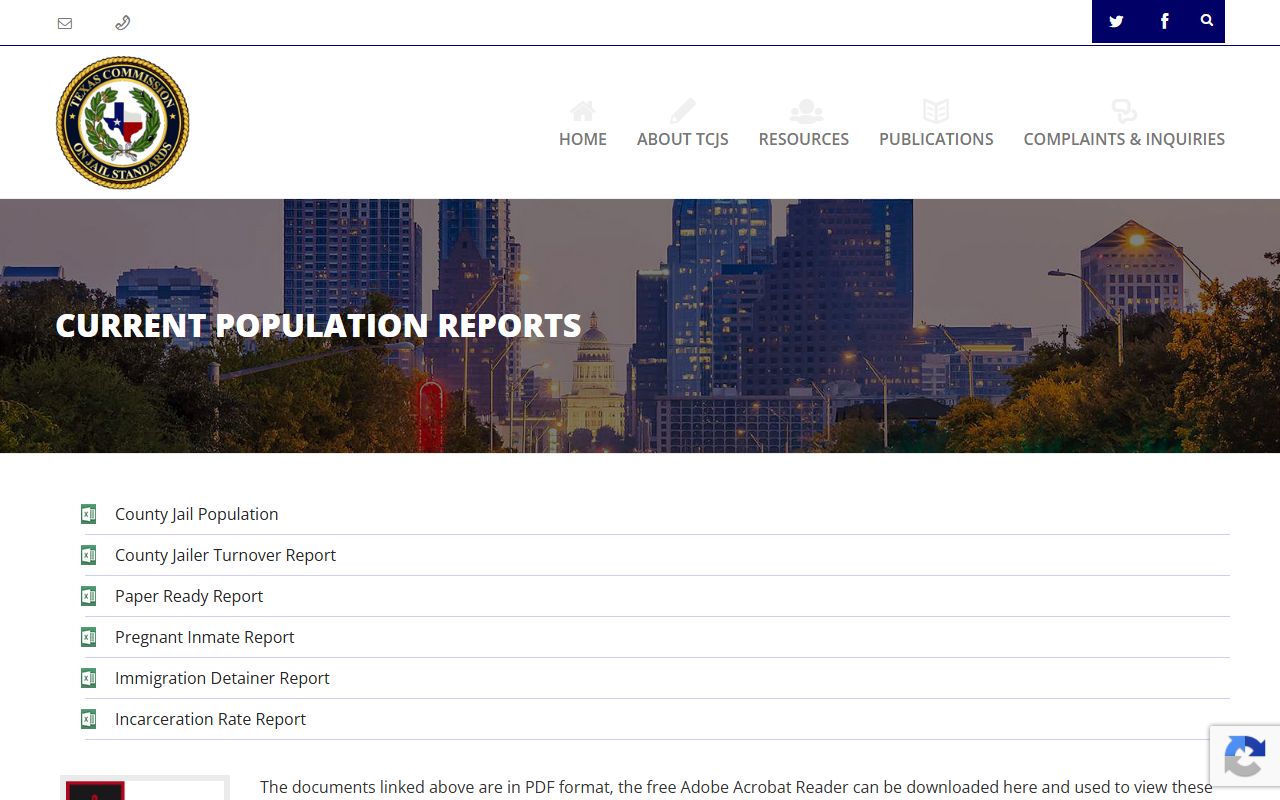
TCJS reporting belongs to the county-jail layer, while TDCJ statistical reports belong to state-prison custody.
Texas Inmate Records Law
Texas public-records requests for executive and local government records are governed mainly by Texas Government Code Chapter 552, the Texas Public Information Act. A useful request asks for existing records from the agency that has them. For a county jail record, that may be a sheriff, county records office, clerk, or local portal. For a TDCJ record beyond ordinary inmate-location information, the agency's Public Information Act form is the state route. Court case records follow court access rules and clerk systems, while judicial administrative records follow Texas Judicial Branch Rule 12 processes.
Key Texas sources: Government Code Chapter 552 governs public-information requests; Government Code Chapter 511 establishes the Texas Commission on Jail Standards; and Texas Judicial Branch open-records policy separates judicial administrative records from court case records.
The Texas Public Information Act source is the statute link used for executive and local government records.
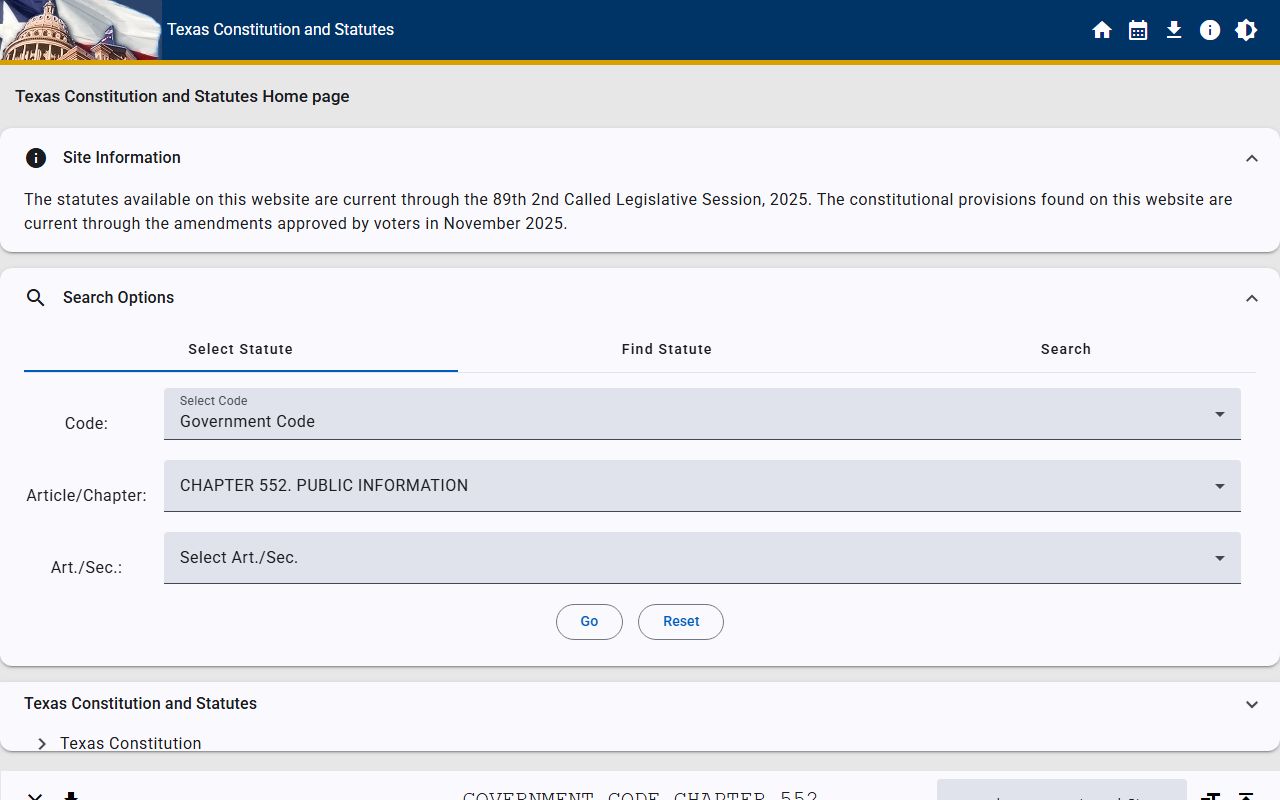
That law does not turn every court docket, phone record, photo, or sealed record into a public download, so the holding agency and record type still matter.
Search Texas State Prison
The TDCJ inmate locator is the main search tool for sentenced state custody. Start with a TDCJ number if known. If the number is not known, use exact name and details such as date of birth, approximate age, county of conviction, or SID number to separate similar names. TDCJ's inmate information page says location, offenses, and projected release date may be obtained online, by email, or by telephone. TDCJ's email information page also states that photos and Social Security numbers are not provided to the public.
- Use TDCJ Inmate Information Search for state-prison and state correctional custody.
- Use the county directory for a recent arrest, pretrial hold, bond question, or local jail roster search.
- Use BOP for federal custody and ICE ODLS for immigration detention.
- Use Texas IVSS-Counties when notification is the goal rather than a one-time lookup.
The TDCJ inmate information page explains the online, email, and telephone routes.
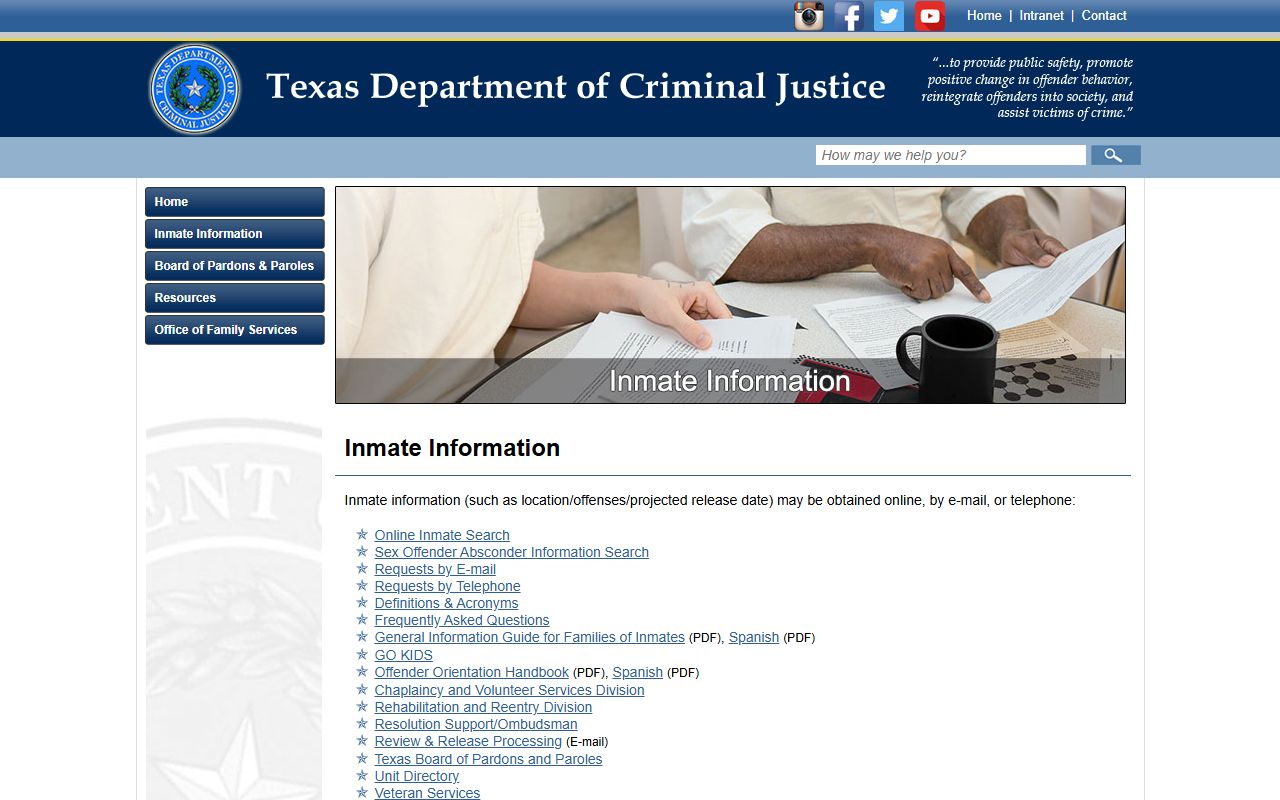
Use that TDCJ route after a person enters state custody, not for every new county jail booking.
The TDCJ locator is the direct state-prison search form.
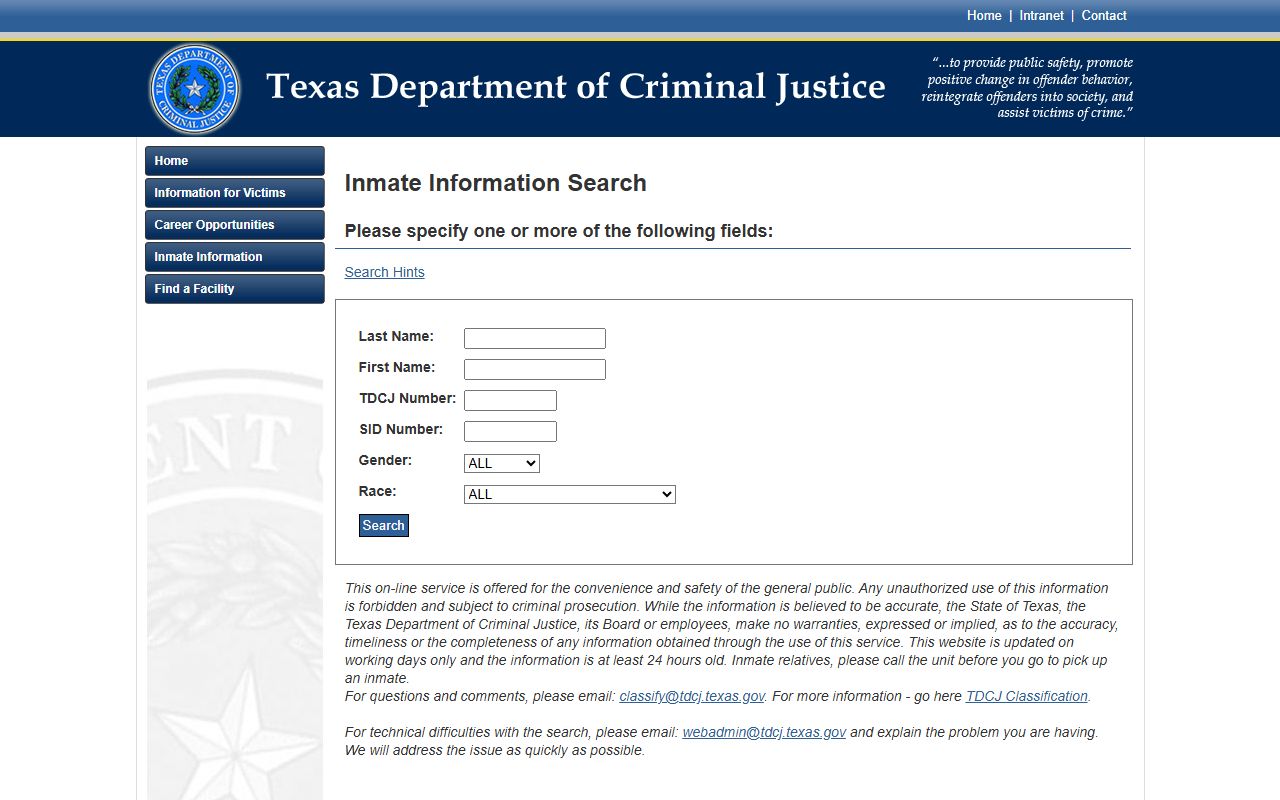
The search result should be read with care because projected release dates can change under parole, mandatory supervision, credit, and detainer rules.
Find Texas Jail Inmates
County jails are the first place to search for recent arrests and pretrial custody. Texas does not have one master county-jail roster that replaces every sheriff's office. Each county site, vendor roster, records unit, or jail phone channel may work differently. The locality directory links to the 254 county subdomain roots using the APEX_DOMAIN_TBD placeholder so the owner can swap the final domain later. The facility directory lists each jail, prison, holding facility, and detention facility row from the research roll-up.
For a county jail search, identify where the arrest happened or where the case is filed. Then use the county folder for the jail roster, booking details, bond status, facility page, and local records process. If the person has already transferred to TDCJ, the county record may show a release, transfer, or sentence event while the active custody record moves to the TDCJ locator.
| Question | Start Here | Why |
|---|---|---|
| Booked today or waiting for first appearance | County Directory | The county jail roster is the current local custody source. |
| Serving a state sentence | TDCJ Inmate Population | TDCJ controls state custody records. |
| Need a facility page | Facility Directory | The statewide list routes to county, TDCJ, BOP, ICE, and regional entries. |
Texas State and Federal Search
BOP and ICE are separate from TDCJ and county jails. The Federal Bureau of Prisons inmate locator covers adults in federal custody from 1982 to present. BOP supports number searches and name searches, and its public form includes first, middle, last, race, sex, and age. BOP warns that release dates can change because of sentence review and time-credit recalculation.
ICE's Online Detainee Locator System applies to immigration detention. ICE states that ODLS requires the person's full name, A-number or date of birth, and country of birth. Search by A-number plus country of birth when possible. If the A-number is not available, use exact biographical details. ICE custody may occur in county, private, or dedicated ICE facilities, but it is not a TDCJ sentence and is not searched through a county roster alone.
The BOP inmate locator is the federal route for adults in federal custody.
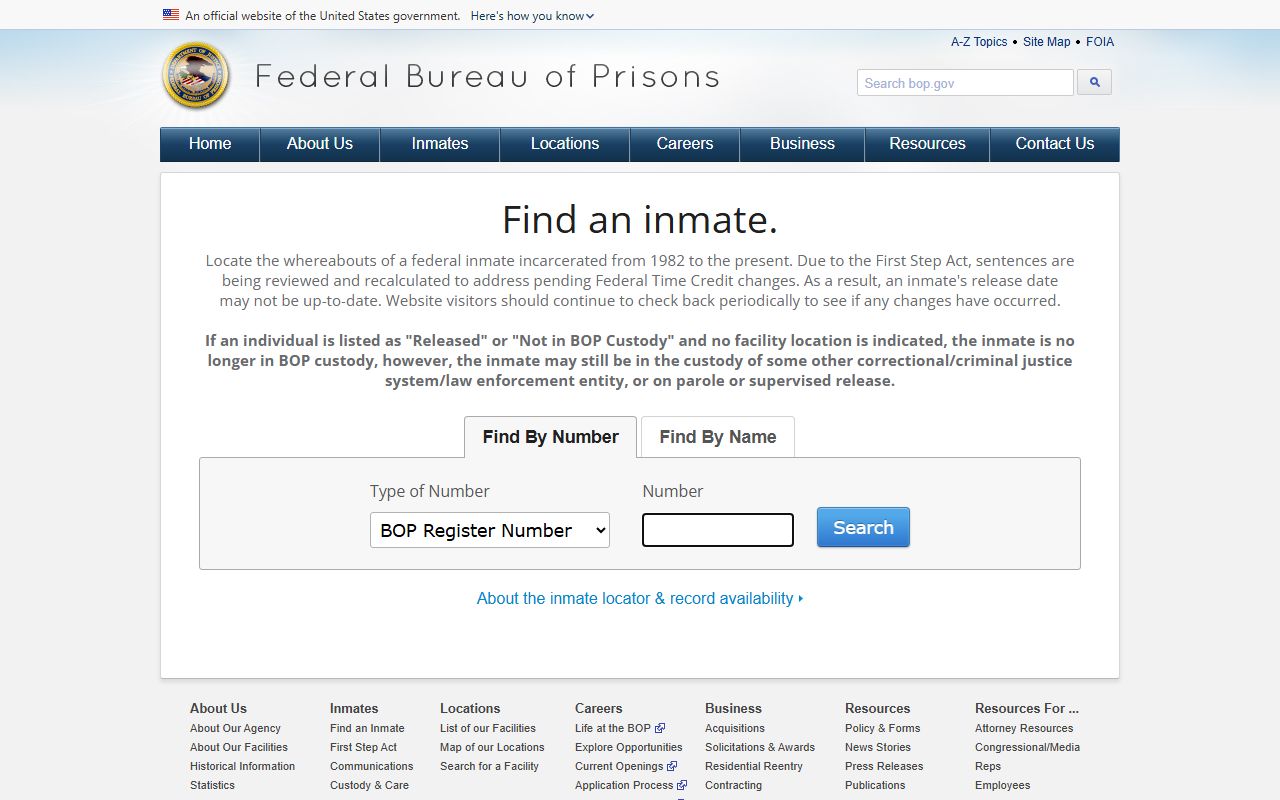
Federal lookup belongs in a separate track because a federal inmate may be in Texas, outside Texas, or in a contract setting.
Texas Notifications and Courts
Texas IVSS-Counties is the statewide notification route described in the research. The Texas Attorney General victim-notification page says Texas transitioned from legacy VINE to Texas IVSS-Counties effective September 1, 2025, and that existing registrations were carried over. The service sends notifications in English or Spanish for booking, release, court-event changes, death, escape, or transfer to TDCJ custody. TDCJ also has an IVSS offender search interface by name, SID, current TDCJ number, or previous TDCJ number.
re:SearchTX is the statewide case-search portal. Its own material says users can find case information from all 254 Texas counties and view hearings and court documents, subject to role and record limits. County district clerk, county clerk, municipal court, justice court, and local vendor portals still matter for local criminal case details.
The Texas IVSS-Counties portal is the notification source named in the statewide research.
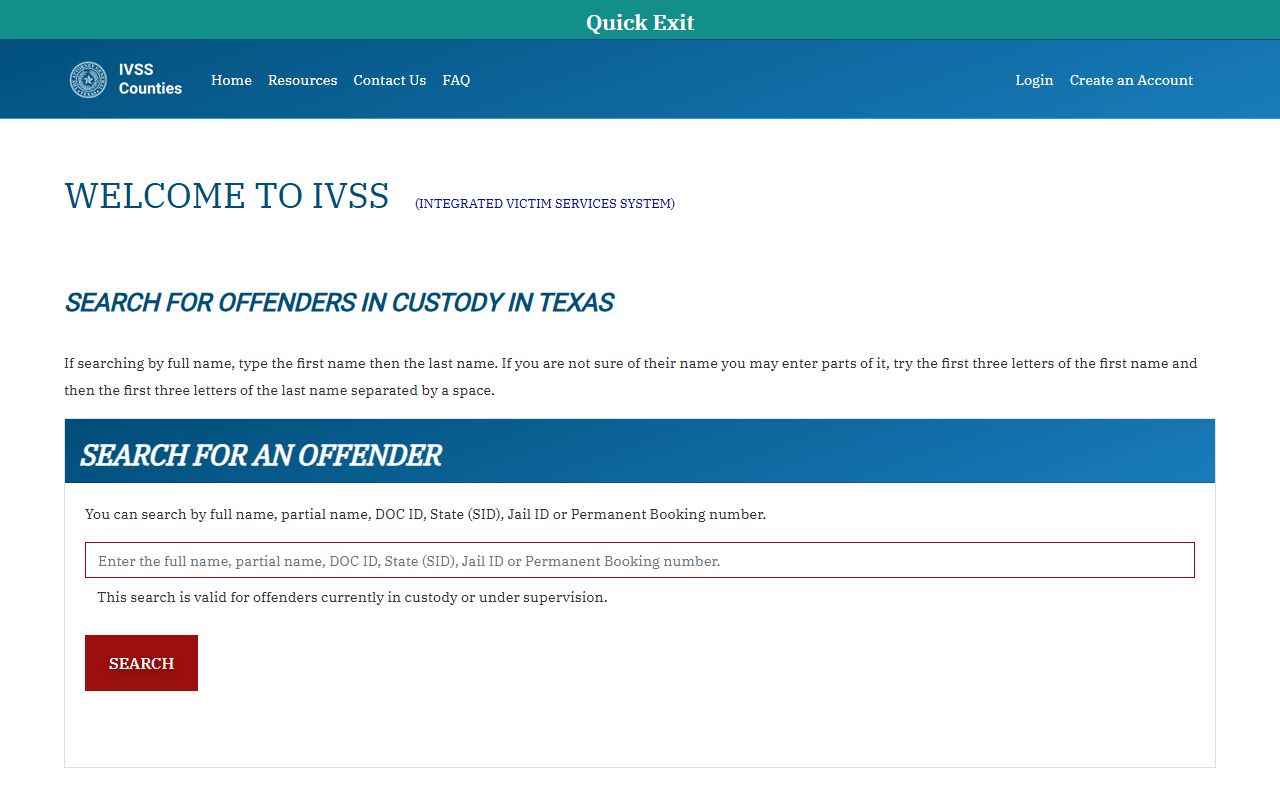
IVSS is useful when a person needs notice of changes, while the jail, TDCJ, BOP, or ICE locator answers current custody questions.
The re:SearchTX portal is the statewide court-record search source in the research.
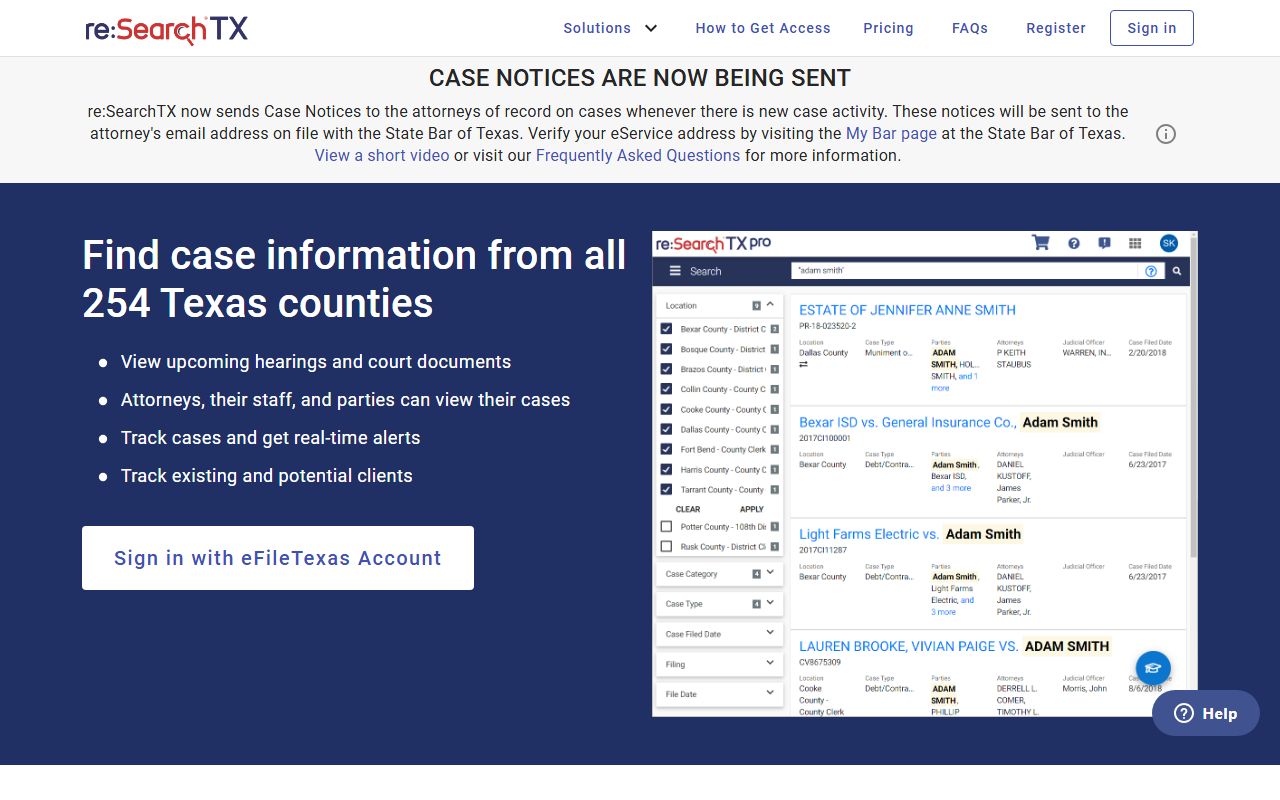
Court records can show charges, hearings, filings, and documents, but they do not always prove current jail custody.
Texas Detention Facilities
The statewide facility directory is broad by design. It includes county jails, city holding facilities, jail annexes, regional jail relationships, TDCJ units, private and contract facilities, BOP institutions, ICE detention centers, community corrections and treatment facilities, juvenile correctional facilities where locality research treated them as relevant, and out-of-state overflow facilities documented by county research. The key question is not the building label. The key question is which agency controls the custody record.
All facility rows in the Texas research are marked covered because all 254 Texas county folders exist and the roll-up was produced from their research files. Covered facility rows link forward to county subdomains with the APEX_DOMAIN_TBD placeholder. Those links are intentionally mechanical and will resolve when the final domain exists.
The TDCJ unit directory shows the state-prison unit layer by region, type, city, and county.
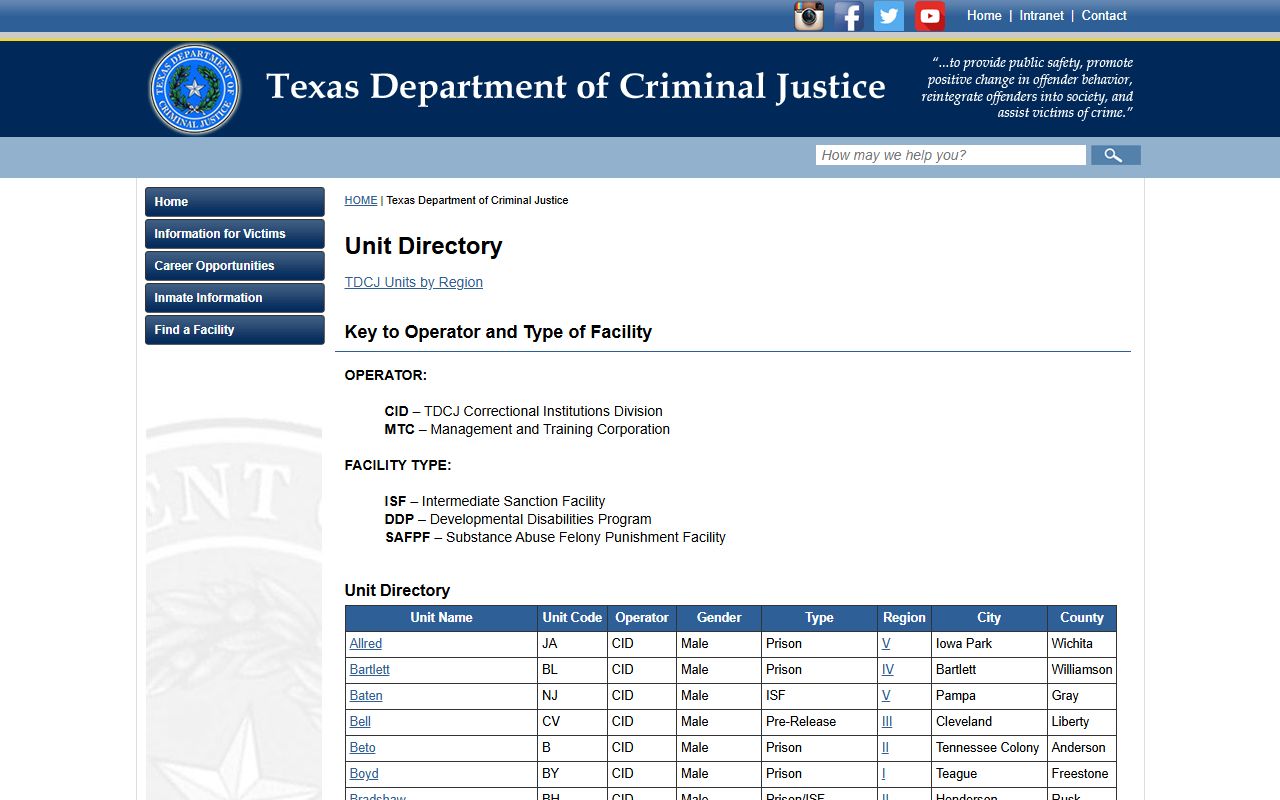
The local facility directory adds county jail, city jail, regional, BOP, and ICE entries around that state-prison unit layer.
Texas Inmate Population FAQ
How large is the Texas inmate population? The sourced statewide prison figure is the TDCJ incarcerated count of 132,230 on August 31, 2025. County jail populations are tracked separately through TCJS and local county systems.
Is there one statewide jail roster? No. Texas jail rosters are county and local systems. Use the county directory for recent arrests and the TDCJ locator for sentenced state custody.
Where do federal inmates show up? Federal inmates are searched through BOP, not TDCJ. BOP records cover adults in federal custody from 1982 to present.
Where do immigration detainees show up? ICE ODLS is the immigration detention locator. ICE requires full name, A-number or date of birth, and country of birth.
Which page lists every facility? The facility directory lists the statewide roll-up of Texas county jails, city jails, TDCJ units, BOP sites, ICE sites, and related detention facilities from the research.